Word Journey: Word Puzzle
Lumica GamesWord
4.627.00 Reviews
- Version
- 1.6.5
- Installs
- 50.00K
- Age Rating
- Everyone
Screenshots
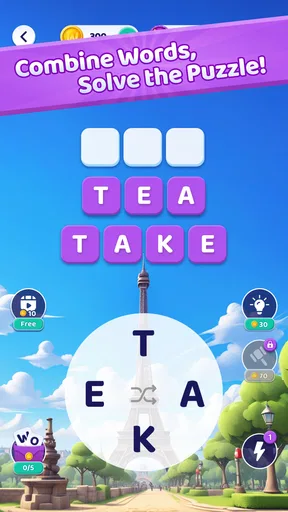
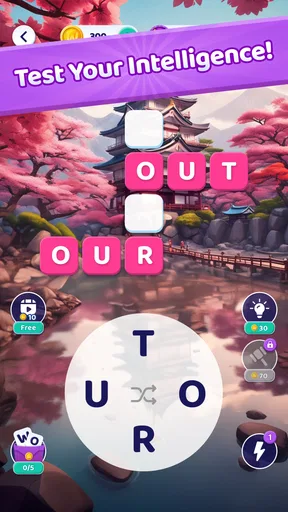
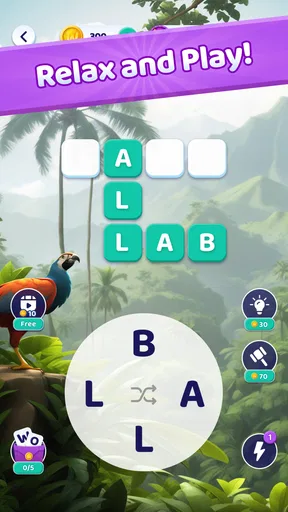
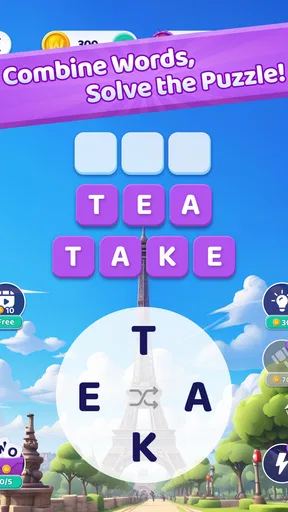
Our Review of Word Journey: Word Puzzle
 Analysis by Appyee
I spent time with Word Journey: Word Puzzle as a light word game, and my first impression was that it understands why people open this kind of app: not to manage a complicated system, but to solve a few clues, connect letters, and relax for a while. It comes from Lumica Games and is available free of charge, which makes it easy to try without treating the first session as a financial decision. The game is listed for Everyone, so its basic concept is suitable for a broad audience.
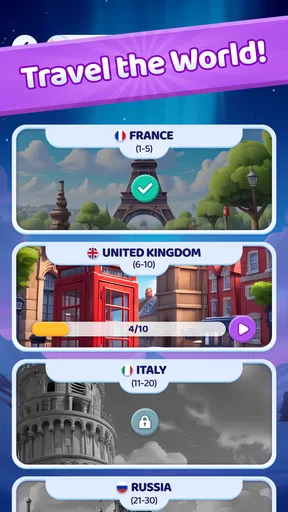
What makes it more appealing than a single-format word game is the sense of movement built into its presentation. The idea of solving word puzzles while travelling around the world gives the individual rounds a little more context than a plain list of disconnected challenges. I would not describe it as a demanding competitive word workout. Its stronger identity is as a calm, accessible word game for short breaks, quiet evenings, or anyone who enjoys finding words without needing a large tutorial.
How the free experience earns its place
The most important buying question is simple here: you can start playing without paying. That matters because this is the kind of game I would recommend testing during an ordinary break rather than deciding from screenshots alone. The free entry point lets you discover whether the letter connections and crossword-style solving feel satisfying to you before you spend anything.
There are in-app purchases ranging from $1.49 to $49.99 per item. I see that range as a reason to be deliberate, not automatically as a flaw. The free access is the core value proposition, while any purchase should be judged by whether it removes a specific annoyance or adds something you genuinely want. I would not buy simply because a difficult puzzle made me impatient. I would first close the game, return later, and see whether the problem was lack of understanding or just a temporary loss of focus.
That approach is especially useful with word games. A hint can feel valuable in the moment, but the satisfaction of solving a puzzle often comes from making the connection yourself. If you are comfortable progressing slowly, the free version is likely to make more sense than treating optional spending as part of the normal routine. If you prefer uninterrupted progress and regularly use paid help in puzzle games, you should decide on a personal limit before playing.
The game currently appears as version 1.6.5 and supports devices starting with Android 7.1. That gives it a reasonably broad compatibility range for Android users with older phones, although compatibility alone does not tell me how smoothly every device will perform. I would still install it on the phone you actually plan to use, particularly if that phone has limited storage or an older processor.
The basic loop is easy to understand
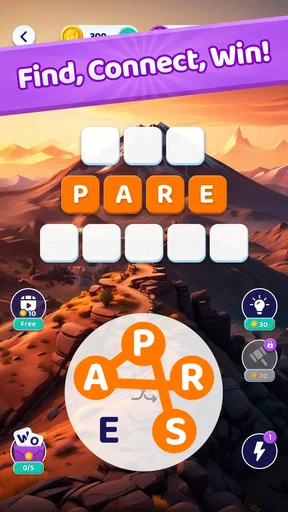
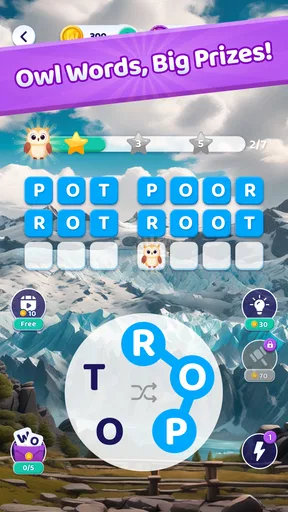
In practice, the appeal comes from connecting letters to form words and using those answers to complete crossword-like layouts. This is a familiar structure, but familiarity is part of the comfort. I did not need to learn a complicated control scheme or remember a large collection of rules before getting started. The focus stays on recognizing possible words and deciding which connection is worth trying next.
I like this format for short sessions because it gives me a clear stopping point. I can solve a small part of a puzzle, put the phone down, and return later without feeling that I have abandoned a long strategy match. That makes it a better fit for a commute, a waiting room, or the few minutes after dinner than a game that expects a long uninterrupted sitting.
The world-travel framing also helps the game feel less static. It does not turn the puzzles into a travel simulator, and I would not install it expecting detailed destinations or a story-driven adventure. Instead, the travel idea provides a gentle sense of progression around the word solving. For me, that is enough when the real goal is to unwind.
Small habits make the puzzles more enjoyable
My most useful tactic was to avoid treating every available letter as part of one obvious answer. I first looked for short, familiar words, then used those discoveries to reveal the structure of the crossword. This is more reliable than repeatedly dragging through random combinations. It also keeps the game from becoming a test of patience when the longer answer is not immediately visible.
Another good habit is to change the way you look at a puzzle after a few unsuccessful attempts. If you are searching only for nouns, you may overlook a common verb or adjective. If you keep trying long words, switch to short ones. The value of this approach is not a hidden feature; it is a practical way to use the game’s letter-connection design more intelligently.
I also found that the game works better as a calm activity when I resist rushing toward assistance. A difficult board can be useful vocabulary practice precisely because it makes me consider alternatives. Players who want every puzzle solved immediately may find this slower method frustrating, but players who enjoy the thinking process will get more from the free experience.
Where it fits among familiar word games
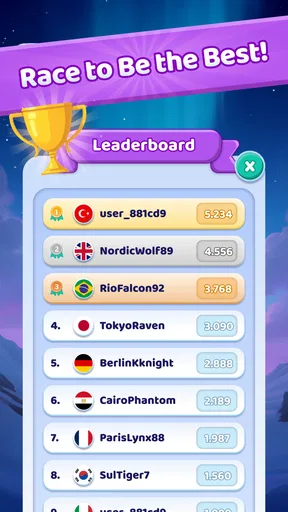
Compared with a daily word guessing game, Word Journey: Word Puzzle offers a broader stream of puzzles rather than centering the experience on one shared answer. That makes it more suitable when I want to play several rounds in one sitting. It also avoids the pressure of comparing my result with friends or waiting for a new daily challenge, at least in the way I experienced its core concept.
Compared with a traditional crossword app, it feels more approachable because the letter connections give me a starting point. A conventional crossword can depend heavily on general knowledge, obscure references, or precise clue interpretation. Here, the available letters narrow the search and make progress feel more visual. The trade-off is that experienced crossword fans may find the format less intellectually varied than a full newspaper-style crossword.
It is also different from a competitive word-board game. There is no reason to approach it as a contest of vocabulary management, tile placement, or opponent reading. I would choose this game when I want a private, low-pressure puzzle session. I would choose a multiplayer word game instead when the main attraction is rivalry, social play, or proving that I can outscore another person.
What the rating and audience suggest
The game holds a 4.6 average from around 448 ratings, with around 27 written reviews, and has passed 50K installs. Those figures suggest that it has found an audience among people who enjoy this particular relaxed word-puzzle style. I treat that as encouraging rather than conclusive: a rating can tell me that many players are satisfied, but it cannot replace checking whether the pace and puzzle format match my own preferences.
The Everyone age classification is another practical advantage for households. I could see it working as a simple shared game for a parent and child, although vocabulary differences will naturally affect who finds a puzzle easy. It is also suitable for adults who want something gentler than a fast action game. The absence of a complicated premise makes it easy to hand to someone who does not normally play mobile games.
At the same time, broad accessibility should not be confused with universal appeal. A player looking for deep narrative, elaborate visuals, or a demanding language challenge may reach its limits quickly. The game’s strength is its approachable loop, and that same simplicity may feel repetitive to someone who needs constant mechanical variety.
Everyday situations where it works best
One realistic use is a ten-minute wait before an appointment. I can open the game, work through a few letter combinations, and stop when my name is called. Because the activity is divided into puzzle steps, I do not need to remember a complex plan after putting the phone away. That is more convenient than starting a game that becomes frustrating if interrupted.
It also suits a quiet evening when I want to do something with my hands but do not want a demanding screen experience. I can focus on a board, try a different word pattern, and let the travel theme provide a little forward motion. For this use, I think the free entry point is important: the game can fill a small amount of time without requiring me to commit to a subscription or a premium purchase.
For language learners, the game may be useful as a low-pressure way to notice common English word patterns, but I would not treat it as a complete learning tool. Solving a word is not the same as understanding its pronunciation, meaning, or usage. Someone studying vocabulary systematically would be better served by a dedicated language app, while someone who wants casual exposure may enjoy the puzzle context.
Friction points worth considering
The main limitation is the possibility of repetition. Letter-connection and crossword formats are naturally focused, so the experience depends heavily on whether you enjoy repeating that central action. If you need new mechanics every few minutes, the travel framing may not be enough to keep the game fresh.
There is also a difference between relaxing difficulty and empty difficulty. When I am stuck because I missed a possible word, the pause feels rewarding. When I am stuck because I am guessing at the game’s expected vocabulary, the experience becomes less satisfying. That is a normal tension in word games, but it means players with very different vocabularies may have sharply different impressions of the same puzzle.
The purchase range is another point of caution. Free access is a real advantage, but optional items can change how comfortable the progression feels depending on how often you use them. My recommendation is to regard purchases as convenience spending, not as something required to prove that the game is worth keeping. If you dislike any game that presents paid options during a free session, this may not be the right style for you.
Players should also be realistic about the device requirement. Android 7.1 is an older minimum operating-system level, which helps people with older phones try the game, but an older supported system does not guarantee an equally pleasant experience on every handset. A current phone should be an easier fit; an aging device may need a quick trial before you decide to keep it installed.
Who should install it, and who should skip it
I think it is a strong match for someone who likes word searches, crosswords, and quiet progression. It is particularly suitable if you want a game that can be played in short bursts, offers a clear mental task, and does not demand competitive interaction. Families may appreciate the Everyone rating, while casual players will likely appreciate being able to begin for free.
I would also recommend it to people who enjoy solving through elimination. The letter connections give you something concrete to inspect, so you can improve your approach instead of relying entirely on vague clue interpretation. If you like finding several possible words and then seeing how they fit together, this is where the game earns its place.
I would skip it if your priority is multiplayer competition, a rich story, or advanced crossword construction. I would also look elsewhere if you want a structured vocabulary course rather than entertainment. A daily puzzle app may be better for a ritual built around one challenge, and a full crossword app may be better for players who want more demanding clues and broader subject matter.
My final buying judgement
After using it, I see Word Journey: Word Puzzle as a pleasant free word game rather than a revolutionary one. Its value comes from combining an easy-to-grasp letter-solving loop with a light travel theme and a format that fits naturally into spare moments. I can recommend trying it because the entry cost is free, and there is enough here for the right player to enjoy without immediately buying anything.
My advice is to install it when you want calm, repeatable word puzzles, not when you are searching for a competitive or story-heavy game. Give the free experience enough time to show whether its rhythm suits you. If you enjoy the boards and can progress without feeling pressured, optional spending may remain unnecessary. If the core loop already feels repetitive, purchases will not solve that underlying mismatch.
Lumica Games has made a straightforward choice: keep the attention on words, connections, and gradual travel-themed progress. That simplicity is both the reason I would recommend it to casual puzzle fans and the reason I would not recommend it to everyone. For a short break, a quiet evening, or an accessible word challenge, it delivers useful value at no initial cost. For deeper competition or more varied puzzle design, a different category of game will be the better choice.
Verdict
Strengths of Word Journey: Word Puzzle
- Relaxing gameplay suitable for short or extended sessions.
- Large vocabulary encourages learning new words naturally.
- Simple controls make it accessible for most age groups.
- Offline play is convenient when traveling or avoiding mobile data.
- Gentle progression provides a satisfying sense of achievement.
Limitations of Word Journey: Word Puzzle
- Some later puzzles may feel repetitive after extended play.
- Hints can make challenging levels less rewarding to complete.
- Difficulty progression is not always consistent between stages.
- Frequent promotional prompts may interrupt the overall flow.
- Players seeking competitive multiplayer may find it too solitary.
Similar Picks in This Category
View All
Word Search - Word Puzzle Game
Bluetile4.8

Word Search Quest - Puzzles
Blackout Lab4.8

CodyCross: Crossword Puzzles
Fanatee, Inc.4.7

Words of Wonders: Crossword
Fugo Games4.9

Wordscapes: Word puzzle game
PeopleFun4.7

Word Search Explorer
PlaySimple Games4.9
Frequently Asked Questions
What is Word Journey: Word Puzzle, and how does the gameplay work?
Word Journey: Word Puzzle is a casual word game built around discovering words from a set of mixed letters. Players swipe or tap letters to form valid answers, complete level-based challenges, and progress through different destinations or themed stages. The early puzzles are generally accessible, while later levels introduce longer words, less obvious combinations, and a greater need for vocabulary and careful thinking.
Is Word Journey: Word Puzzle free to download and play?
The game can generally be downloaded and played without an upfront purchase, but it may include optional in-app purchases. These purchases can be used for hints, coins, extra assistance, or other convenience features. Advertising may also appear between levels or during normal play. Before downloading, users should check the current store listing and in-game purchase information, especially if the app will be used by children.
Can Word Journey: Word Puzzle be played offline?
Many word puzzles can usually be enjoyed without a continuous internet connection, which makes the game suitable for short trips, commuting, or areas with limited service. However, certain features may still require internet access, including advertisements, purchases, cloud synchronization, updates, events, or account-related functions. Offline availability can vary by version and device, so it is best to test the game after installation rather than assuming every feature works offline.
Does Word Journey: Word Puzzle offer hints or help when a level becomes difficult?
Yes, the game is designed to provide assistance when players are stuck, commonly through hints, coins, or similar support items. These tools may reveal a letter, remove an incorrect option, or help identify a possible word, depending on the current version. Because hints can be limited or connected to rewards and purchases, experienced players may prefer saving them for particularly challenging levels instead of using them immediately.
Is Word Journey: Word Puzzle suitable for children and all skill levels?
Word Journey: Word Puzzle is easy to understand and can be suitable for casual players, families, and people who enjoy vocabulary-based challenges. It does not usually require fast reflexes, making it approachable for a wide age range. Nevertheless, difficulty can increase significantly, and younger players may encounter unfamiliar words or advertising. Parents should review the app’s age rating, privacy details, advertising settings, and purchase controls before allowing unsupervised play.
Play our best games!


